
Versus
I was renamed at eighteen months. Fifty years later, I sat down to rename a child myself.

The lawyer slid the papers across the desk and I picked up the pen, and that was when it hit me.
Not what I was doing, but a memory of something else. She was in the next room, my granddaughter, swinging her feet on a chair too tall for her, and I was about to change her name.
I noticed my hand trembling a bit, trying to piece together what was in my head.
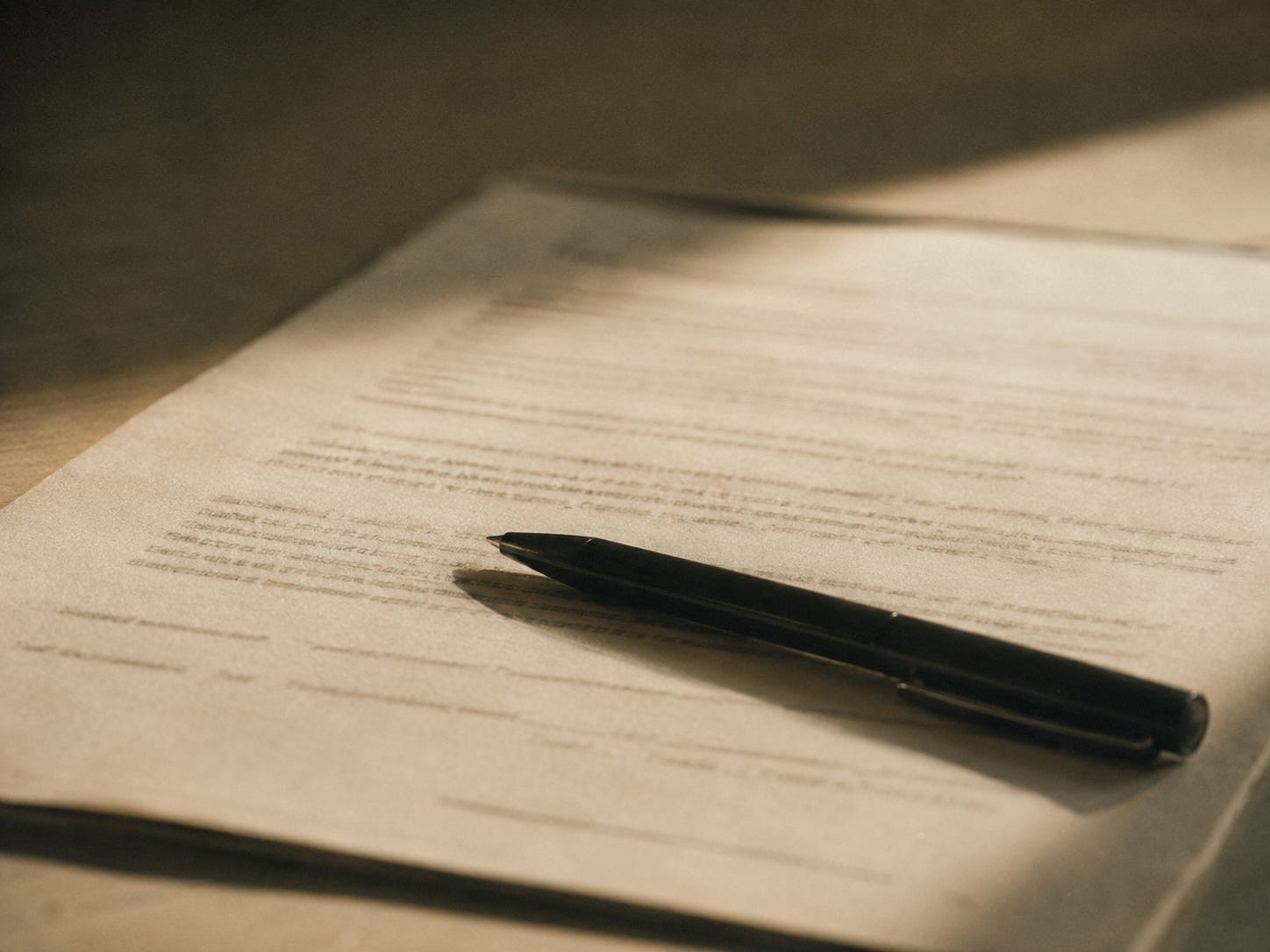
I was six the first time I saw what a document like this looks like from the other side. I found it in a cabinet I had no business in. My father’s name, then mine, with a word set between them.
Versus.
My old name on one line, my new name on another. I sat on the floor and understood, in the only way a boy that age can understand, that my father had taken me to court. That he was against me.
It took me three years to understand it meant the opposite, alone, the way I worked most things out back then.
And now the pen was in my hand, and I was where my father had been.
They told me at nine. Sat me down, explained it the way you explain something you’ve rehearsed, and asked if I had any questions. I’d found the papers three years before and worked it out by then.
I said no, and they looked relieved. I remember thinking they probably hadn’t expected it to go that easily.
We told her at nine too. I noticed the number later, the way you notice these things after.
But she was not me, and her nine was not my nine. The questions came, and they kept coming, and almost none of them were about the name or about us.
They were about her mother.
The woman she had met when she was six and taken for her sister. She was working out how her sister could be her mother. I had spent my ninth year keeping a door shut. She spent hers asking to have one opened.
So there I was with the pen, and I started to cry, and I couldn’t tell where one reason ended and the next began.
Some of them were for her. I knew what I was handing her along with the name. A day, years out, when she might find what I found and have to make sense of it alone, the way I did. I was signing that into her life the same as I was signing the name.
Some of them were for the boy on the floor in front of the cabinet. I understood what those papers meant before I ever let myself feel it. Sitting there with the pen, the feeling finally caught up. Fifty years late, in the wrong room, for the wrong reason, but it caught up.
And some of them, I understand now, were for my father, who sat where I was sitting and held a pen, like I had, and never said a word to me about what it took. He couldn’t have told me. There’s no telling it.
You only learn what that day costs by being the one who signs it, and by then the man who could have told you is gone.
I’ve stopped trying to divide them up. I think the truth is they were for all three at once, the boy and the girl and the man, all in one room that only had one of us in it.
It’s Father’s Day as I write this. Both of them are gone now, my father and my mother, and there’s no one left to call and ask what that day in court was like from their side.
So I went looking the only place left to look, which was the day I became the one signing. That’s where I found him. Not in a memory of him.
In my own hand, shaking a little, holding the pen.
"Not in a memory of him. In my own hand, shaking a little, holding the pen." Beautiful line.