
The Drive Out
Three hours alone in the car, and the work was already happening.

The appointments were always at night, so the driving started around noon.
Some days earlier, if there'd been a sales meeting on the far side of Atlanta first, which meant crossing the whole city before I'd even pointed the car the right direction.
By the time the suburbs thinned and the billboards stopped, I had three hours of road in front of me, headed somewhere cable hadn't reached yet.
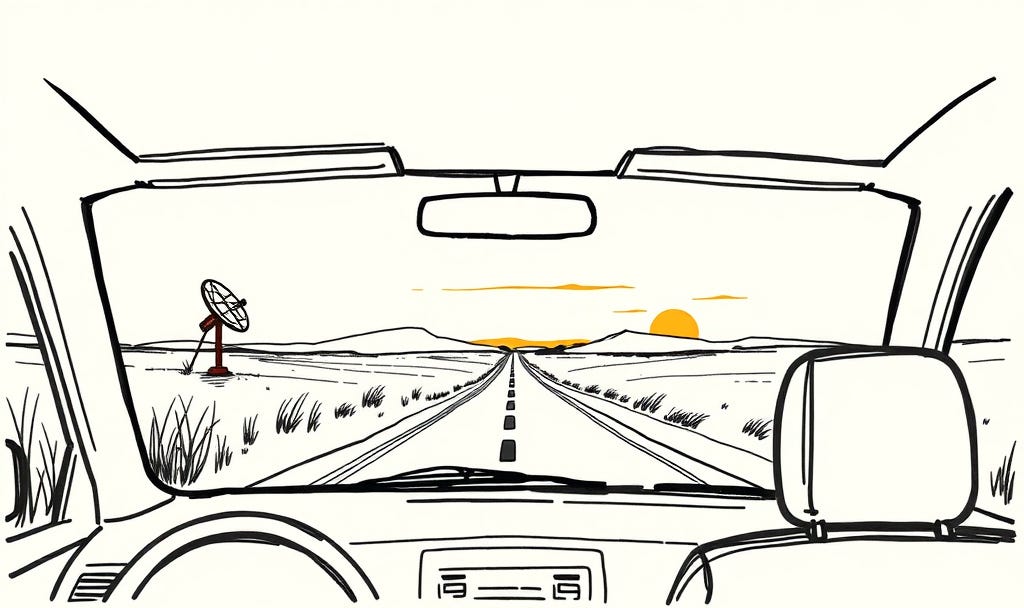
That was the territory. Places the cable companies hadn’t run line to, which is a polite way of saying places far enough out that nobody had thought them worth the trouble.
A few channels if they had anything, the ones an antenna could still pull out of the air on a good night. What I was selling was the 7-foot dish, the one that came after the giant motorized things and before the little pizza-box dishes everybody has now.
I knew I was getting close when I started seeing those giant ones in the side yards, rusted through, the motors long seized up, somebody’s better TV from ten years ago gone to weeds.
You’d think a drive like that would empty you out. Long stretch of interstate, then the state roads, then the kind of road where you slow down for someone’s dog.
Nobody to talk to.
But I was never quite alone in the car, because somewhere on that drive I’d start putting someone in the passenger seat. Not on purpose at first. It was just that the closer I got, the more the person at the other end of the drive started taking shape, and I’d find myself thinking less about what I was selling and more about whoever was going to open the door.
I need to be honest about the fact the person I put in the seat was never the buyer, even though it would sound better that way.
I wasn’t running numbers on who could afford the dish or rehearsing what I’d say when they balked at the price. I was picturing a man coming in from work with his lunchbox or his toolbelt, tired in the particular way of someone whose day was mostly physical, wanting nothing more complicated than to sit down for a while before bed.
And I’d follow him in. Dinner, the table, the kids if there were kids, the long exhale of a person who’s finally off their feet. Then the part I kept landing on, the moment he reaches for the one easy thing he’s been looking forward to and finds four channels of nothing, or snow, or a ballgame in a blizzard of static.
Not a crisis. Just a small sour note at the end of a day that didn’t have much give left in it.
That picture is doing something I didn’t have language for then. It looks like the thing every sales trainer tells you to do, imagine the customer, get into their world, walk in their shoes.
But I wasn’t trying to feel what he felt. I was trying to figure out where his head would be when I got there.
I guessed he’d be worn down but content enough, and not looking for someone coming in to improve his life. Come in with a pitch about what he was missing and I’d be a stranger talking up at a man who only cared about sitting down. That wasn’t kindness, it was starting from who he was, not who a sales trainer told me he’d be.
So by the time I was on the porch, I’d already been with him for three hours. He just didn’t know it yet.
The door would open on about what I’d pictured. A man still half in his workday, maybe the work shirt still on, the television already going in the other room. And whatever else a man like that expects from a salesman at the door at night, it’s the pitch. He’s waiting for it. Thinking to himself, “Here comes the part where I find out what I’m supposed to want.”
After the hellos, I’d usually say something close to this. “I’m guessing TV isn’t the biggest problem in your life today.”
The dish was the only thing I’d come to sell, and I’d driven three hours with nothing else in the car. But the first real thing out of my mouth was that the thing I was there for probably didn’t matter much.
I said it because by then I believed it, having ridden out with him the whole way, and because the man in the doorway already knew it was true. His life was the job and the family and whatever was waiting on him tomorrow. The four channels were a nuisance, not a bruise.
Naming it as the small thing it was, out loud, before he had to, was the only thing I could have said that he’d have recognized as honest.
Sometimes that was enough and we’d just start talking. But if he gave me the look that said he was still waiting for the catch, I’d go a little further.
“You’ve got something already. It works well enough. I’m not here to tell you your life is missing a satellite dish. I’m here to see whether there’s anything about how you watch TV now you’d improve, if it made sense.”
I gave him back his own life as something that already worked. Not as a setup, not as the warm thing you say before you take it away. I said it because it was true, and because the man had very likely been told otherwise before. Out in that yard, rusting, was the last thing somebody had driven out to tell him he couldn’t live without.
So when I said I wasn't there to tell him what he was missing, the pitch he was waiting to resist never arrived. There was nothing to argue with, because I'd already agreed with him.
And then the part I didn’t understand the worth of until much later.
That little “if it made sense” at the end. I put the “if” right out in the open where he could see it.
I came all that way and genuinely handed him a way out. Because a man who’s allowed to say no is the only kind who’ll actually think in front of you. The other kind just ushers you toward the exit, nodding, waiting for you to leave.
That was the whole move, though I wouldn’t have called it a move. I lowered the stakes until there was almost nothing left to defend, letting him look at the thing honestly.
Tell a tired man this matters enormously and he stiffens. Tell him it’s a small thing, maybe worth a look, and then it’s safe enough to consider.
Less pressure didn’t mean less serious. The less I pressed, the more room there was for something real to happen, which is backwards from how I’d been taught to sell.
I used to think the drive was just the table stakes of the territory. Three hours out because that’s where the people without options were, three hours back because the dish wasn’t going to sell itself from my driveway.
Dead time bracketing the real work.
It was the other way around. The work was the drive.
By the time I arrived I was someone who’d thought about him as a man in a chair at the end of a day rather than a signature at the end of a night. The conversation on the porch was just where it became apparent. Whatever I read at the door, I’d mostly read on the road.
And the read was never about what he didn’t have.
That’s the part I keep coming back to. Everything I said on that porch started from what was already working in his life, not from the hole I’d come to fill. I led with the dish not mattering. I gave him back his evening as good enough. I left the no sitting open where he could reach it. None of it was a way of getting to “here’s what you’re missing” by a different route, it just didn’t go there at all.
I don’t think the lesson is be gentle, or picture your customer, or any of the things it looks like from the outside.
I’m not sure it’s a lesson. It’s just what I saw, once I stopped to look at it: that the man who feels nothing is missing isn’t waiting for you to show him the gap. He’s waiting to find out if you’re going to be one more person who insists there is one.