
I Built An AI To Catch The Voice I Couldn't Hear
It still misses things. Just not the same things I do.

A few days ago I agreed to an interview about how I use AI with Nizamuddin Siddiqui. He asked about the one AI workflow I’d fight to keep.
I said I use AI to check myself rather than having it write for me. That became the headline for the piece.
It’s true. It’s also the kind of answer that sounds better than it is. Like a man with a disciplined system.
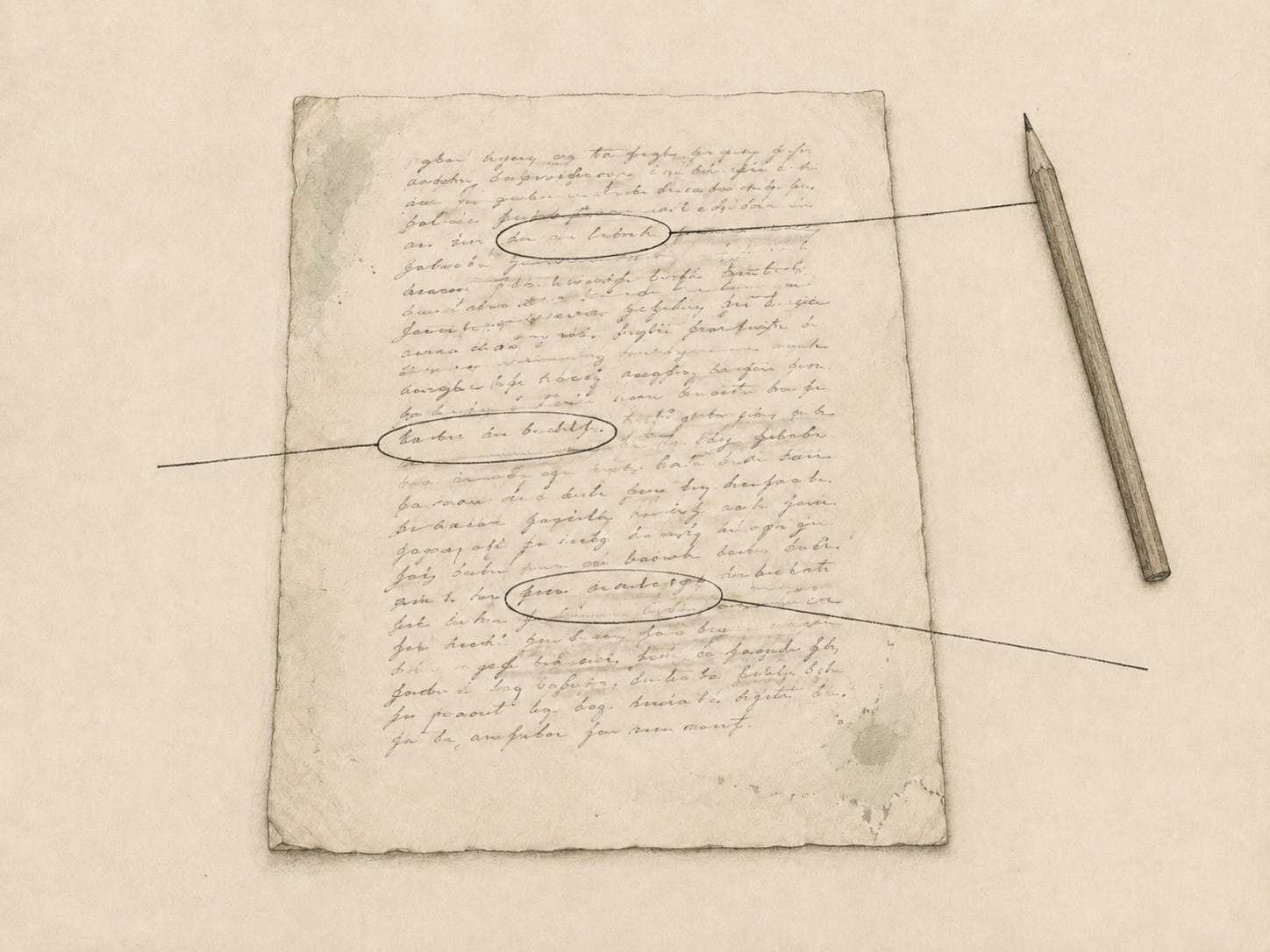
The Draft I Had Already Decided Was Good
Here’s what actually happened.
On December 26th I wrote an essay. It was going to be one of the first application pieces in a new category I’d just spent months defining, moving from Aligned Influence to Calibrated Influence, from teaching people what to do to reading what’s happening.
I loaded my voice rules before I started. The machine confirmed them back to me. Then I wrote fifteen hundred words that felt right, and I filed them away in Drafts.
Sixteen weeks later I ran that essay through the thing I’d built to catch me. It came back 6.5 out of 10.
My first reaction was irritation. Not at the score, at the machine.
Maybe the instructions were too black and white. Or maybe my tool was confusing clarity with teaching. Surely it could understand why some things had to be direct?
Then the machine gave me a list of my own sentences:
“Pay attention to what happens in your body the next time someone hesitates at your price.”
“So the next time you feel that pause before someone says no, try something.”
“Notice where the tension forms. Notice the story that’s starting to build.”
I read them once, and then again. I was still irritated. I just wasn’t irritated at the machine anymore.
The machine was right.
Teacher cadence, all three. Standing above the reader, telling them what to do.
The essay meant to announce that I’d stopped teaching was written in the voice of a teacher.
I wasn’t as bothered that I had written those words as I was by how completely they passed as the new voice when I did.
The Drift That Sounded Like Me
The easy explanation is I got sloppy. That isn’t what happened.
I followed the rules. I wrote every sentence in that essay believing it was the new voice. When I typed “Pay attention to what happens in your body,” it didn’t feel like a violation. It felt like the truest thing I could say.
I guess that’s what made the result uncomfortable. The problem wasn’t that I ignored the standard. The problem was that I was the one who wrote the standard, wrote the essay, and the one that decided whether the essay met it.
The failure wasn’t in the standard. It was in applying it from inside the same habits the standard was meant to catch.
I had built a closed loop and mistaken it for self-awareness.
A few months later I published a piece called The Downside of Experience. The argument was that after enough years you stop looking at what’s in front of you and start matching it to what you’ve seen before.
I published that. I’d already done it. When I sat down that December, I didn’t reach for the sentence that would meet the new standard. I reached for the one I’d been reaching for since 1996.
And because it was familiar, it felt right.
That may be the hardest kind of drift to catch. Not the sentence that sounds wrong, the sentence that sounds exactly like you.
The Voice That Rewards You
Old habits don’t survive only because they are automatic. They survive because they give us something.
The teacher voice made me feel useful. It let me turn uncertainty into direction. It also relieved me of having to leave the reader with something unresolved.
That cadence had been rewarded for decades on stages in front of rooms full of people. In hundreds of training sessions and actual sales interactions sitting across from people who expected me to know.
So when it showed up in the essay, it looked like competence when it really was regression.
That’s the problem with a voice you have outgrown. It usually still works. It may even work better than the voice you are trying to grow into.
The old voice knows where the furniture is. It can cross the room in the dark. The new one still reaches for walls.
The Distance I Didn’t Have
I’ve spent my whole working life reading other people. The pause that’s a half-beat too long, or the yes that comes too fast. Even the moment someone starts telling you what you want to hear instead of the truth.
It’s the one thing I’d say I’m good at.
And yet I couldn’t do it to myself on a page I’d written.
But reading requires distance. When I sit down to write, I’m the only one in the room.
Distance lets me notice what participation hides. Participation lets me feel what distance can’t know.
That doesn’t mean I am incapable of self-awareness. It means self-awareness is incomplete. Some drift can be caught from the inside, some can’t.
So I built something to sit in that other chair.
It isn’t really that sophisticated. It’s a set of instructions I wrote down once.
I wrote down what my voice sounds like when I am reading people and situations honestly and what it sounds like when I have slipped back into teaching.
I check my draft against the rules, but I don’t ask if the draft is “good.”
Since “good” is undefined, the machine has to supply the standard. That version may be clearer and cleaner, but it wouldn’t necessarily be mine.
The standard had to come first.
I had to decide what I was trying to become, and what I was no longer willing to accept, before the machine could point out the difference.
Otherwise, I wouldn’t be using AI to protect my voice, I’d be using it to invent one.
What the Checker Actually Does
The Judge runs eight checks that basically answer three questions:
Am I interpreting, or instructing?
Where has my old cadence returned?
Is there a sentence in here that changes how a reader sees the thing, or does it only explain what they already knew?
Then it quotes the exact drift sentence by sentence, because a general judgment is easy to dismiss.
It’s not a writing tool; it doesn’t rewrite the draft. It just provides a diagnosis.
Sure, there’s a score at the end. But the sentence-by-sentence violations do the work. That’s what made April different from the two times I’d read the piece myself.
The Judge showed me the sentences I had been defending as mine.
The System Inherits Its Maker
Of course, this creates another problem.
I wrote the rules, chose the categories, decided what counted as drift, and then interpreted the machine’s findings.
I had not escaped my own judgment. I had built friction against it.
That matters.
My checker can’t excuse me from judgment because judgment is still required to build it, use it, and decide when it is wrong.
The system inherits the limits of the person who made it, especially when that system is designed to judge the maker.
The Judge read the interview a dozen times and never once told me I had used the word “actually” in half the answers.
I found that myself, rereading after I had already sent it in. It has passed drafts I later took apart and flagged sentences I decided to keep.
It misses things. Same as I do.
Just not the same things. And that turns out to be the only reason it is useful.
If our catches and misses were identical, I would not have built another perspective.
I would have built a mirror.
A Second Kind of Blindness
I used to think the value of a checker was that it could see what I couldn’t. That is only partly true.
The more honest version is that it cannot see everything either. It just misses from somewhere else.
Because we miss in different places, some of the drift becomes visible between us.
Neither of us is sufficient. Together, we are still not objective. But we are less enclosed. That’s our arrangement.
Not human judgment replaced by machine judgment. Human judgment interrupted by a second kind of blindness.
There is drift in this one too. I just have not found it yet.
Hey Joe. This is great 👍
Outside perspective is always valuable, even if not welcome in the moment.